Results for "Microeconomics Test Bank"
Chapter 15: Monopoly - Principles of Economics Test Bank Mankiw
Chapter 15: Monopoly

1. Monopolies use their market leverage to
a. charge prices that equal minimum average total cost.
b. attain normal profits in the long run.
c. restrict output and increase price.
d. dump excess supplies of their product on the market.

2. If government officials break a natural monopoly up into several smaller firms, then
a. competition will force firms to attain economic profits rather than accounting profits.
b. competition will force firms to produce surplus output, which drives up price.
c. the average costs of production will increase.
d. the average costs of production will decrease.

3. Sizable economic profits can persist over time under monopoly if the monopolist
a. produces that output where average total cost is at a maximum.
b. is protected by barriers to entry.
c. operates as a price taker rather than a price maker.
d. realizes revenues that exceed variable costs.

4. Most markets are not monopolies in the real world because
a. firms usually face downward-sloping demand curves.
b. supply curves slope upward.
c. price is usually set equal to marginal cost by firms.
d. there are reasonable substitutes for most goods.

5. Patents grant
a. permanent monopoly status to creators of scientific inventions.
b. permanent monopoly status to creators of any intellectual property.
c. temporary monopoly status to creators of scientific inventions.
d. temporary monopoly status to creators of any intellectual property.

6. If a monopolist can sell 7 units when the price is $3 and 8 units when the price is $2, then marginal revenue of selling the eighth unit is equal to
a. $2.
b. $3.
c. $16.
d. –$5.
Chapter 15: Monopoly - Principles of Economics Test Bank Mankiw

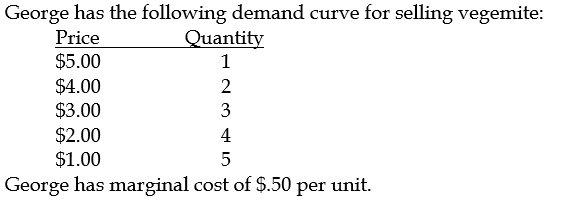
7. What is George’s profit-maximizing level of output?
a. 1
b. 2
c. 3
d. 4

8. What is George’s profit-maximizing price?
a. $4
b. $3
c. $2
d. $1

9. If a monopolist’s marginal costs shift up by $1.00, then
a. the monopoly price will rise by $1.
b. the monopoly price will rise by more than $1.
c. the monopoly price will rise by less than $1.
d. there is no change in the monopoly price and profits fall.

10. If a monopolist has zero marginal costs it will produce
a. the output at which total revenue is maximized.
b. in the range in which marginal revenue is still increasing.
c. at the point at which marginal revenue is at a maximum.
d. in the range in which marginal revenue is negative.

11. The supply curve for the monopolist
a. is horizontal.
b. is vertical.
c. is a 45-degree line.
d. does not exist.

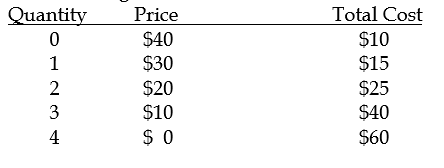
Consider the following demand and cost information for a monopoly.
Chapter 15: Monopoly - Principles of Economics Test Bank Mankiw


12. The marginal revenue of the second unit is
a. $10
b. $20
c. $30
d. $40

13. The marginal cost of the fourth unit is
a. $60
b. $40
c. $20
d. $10

14. The maximum profit this monopolist can earn is
a. $40
b. $30
c. $20
d. $15

15. To maximize profit, the monopolist sets price at
a. $40
b. $20
c. $0
d. $10

16. Suppose potatoes were produced in Canada by many, many firms in perfect competition. In Belgium, only one firm produces potatoes for the Belgium market. Suppose further that for the competitive firms and the monopoly minimum ATC is the same. We would expect that in Belgium the price of potatoes is __________ and __________ potatoes are produced and sold than in Canada.
a. higher; more
b. lower; more
c. higher; fewer
d. lower; fewer

17. “Monopolists do not worry about efficient production and cost saving since they can just pass along any increase in costs to their consumers.” This statement is
a. false; price increases will mean fewer sales, and lower costs will mean higher profits (or smaller losses).
b. true; this is the primary reason why economists believe that monopolies result in economic inefficiency.
c. false; the monopolist is a price taker.
d. true; consumers in a monopoly market have no substitutes to turn to when the monopolist raises prices.

18. Many economists criticize monopolists because they produce at output levels that are not efficient. That is to say, monopolists
a. charge too high a price.
b. don’t innovate.
c. produce a large quantity of waste.
d. have no incentive to produce at their minimum ATC.

19. Concerning public utilities, the stated reason for resorting to regulation of a monopoly, rather than promoting competition through antitrust, is that the industry in question is believed to be a
a. profit-maximizing monopoly.
b. producer of externalities.
c. revenue-maximizing monopoly.
d. natural monopoly.

20. Splitting up a monopoly is often justified on the grounds that
a. consumers prefer dealing with small firms.
b. small firms have lower costs.
c. competition is inherently efficient.
d. nationalization is a less-preferred option.

21. The first major piece of antitrust legislation was the
a. Clayton Act.
b. Celler-Kefauver Act.
c. Sherman Act.
d. Robinson-Patman Act.

22. The task of economic regulation is to
a. protect monopoly profits.
b. approximate the results of the competitive market.
c. replace competition with government ownership.
d. increase competition within the market.

23. Which of the following is an example of price discrimination?
a. Nabisco provides cents-off coupons for its products.
b. Amtrak offers a lower price for weekend travel compared to weekday rates on the same routes.
c. Hotel rates for AAA members are lower than for nonmembers.
d. All of the above are correct.

24. A monopolist that practices perfect price discrimination
a. creates no deadweight loss.
b. charges one group of buyers a higher price than another group, such as offering a student discount.
c. produces the same monopoly level of output as when a single price is charged.
d. charges some customers a price below marginal cost because costs are covered by the high-priced buyers.

25. A monopolist’s profits with price discrimination will be
a. lower than if the firm charged a single, profit-maximizing price
b. the same as if the firm charged a single, profit-maximizing price.
c. higher than if the firm charged just one price because the firm will capture more consumer surplus.
d. higher than if the firm charged a single price because the costs of selling the good will be lower.

Pretty.Much Monday, November 14, 2016
Chapter 22: Frontiers in Microeconomics - Principles of Economics Test Bank Mankiw

1. Moral hazard occurs when
a. the principal monitors an agent.
b. two people might trade with each other and one person has relevant information about some aspect of the product’s quality that the other person lacks.
c. an agent lacks an incentive to promote the best interests of the principal, and the principal cannot observe the actions of the agent.
d. an agent monitors the principal.

2. Carlos, who knew nothing about construction, paid Joe to remodel a room in his house. Two years later, the wall of the new room crumbled because Joe used poor-quality materials. This is an example of
a. adverse selection.
b. screening.
c. moral hazard.
d. signaling.

3. Monitoring an agent means
a. reducing asymmetric information the agent possesses.
b. obtaining information about the agent’s actions.
c. increasing the costs of moral hazard.
d. reducing the costs of adverse selection.

4. The fact that someone with a high risk of medical problems is more likely to buy a lot of health insurance is an example of
a. adverse selection.
b. monitoring.
c. moral hazard.
d. irrational behavior.

5. Adverse selection occurs when
a. people are not as careful after they buy insurance.
b. owners take better care of their homes than do renters.
c. good cars are underpriced in the used-car market.
d. there is separation of ownership and control.

6. What would be the equilibrium price of used cars if 4/5 of them were faulty and worth $1000 while 1/5 of them were good quality and worth $2000?
a. $1000
b. $1200
c. $1800
d. $2000

7. Guarantees may not completely eliminate adverse selection problems because
a. no one guarantees a product 100%.
b. getting the firm to honor a guarantee is too much work.
c. a firm that makes low-quality products may issue guarantees and then go out of business.
d. a firm offering guarantees subjects itself to lawsuits concerning their obligations.

8. Which of the following is an example of a principal-agent relationship?
a. buyer-seller.
b. client-accountant
c. parent-nanny.
d. Both B and C are correct.

9. The principal-agent problem arises because of
a. the firm’s motive for profit maximization.
b. the salary differential between management and laborers.
c. the structure of the market in which the firm operates.
d. conflicting interests between a principal and an agent.

10. Suppose that the Boston Red Sox hire Homer Jones as a first baseman. One day, the manager tells Homer not to swing at a pitch so that he can get a walk and help the team win the game. Homer, however, wants to hit a home run so that he can improve his value on the free agent market, so he swings at the next pitch and misses the ball. This is an example of
a. moral hazard.
b. adverse selection.
c. signaling.
d. the principal-agent problem.

11. The principal-agent problem is more serious in large firms than in small firms because
a. monitoring employee activity in large firms is generally more difficult.
b. employees in large firms have less information.
c. profits increase with the size of the firm.
d. customers expect better treatment from small firms and they usually get it.

12. The __________ voter is the voter whose views on a policy issue are in the middle of the spectrum, with half of the other voters on one side of this voter’s view and half on the other side.
a. average
b. mean
c. Arrow
d. median

13. If voter A would like the government to spend $10,000 on a project, voter B prefers $5000, voter C prefers $3000, voter D prefers $2000, and voter E prefers $0, how much spending would a politician seeking as many votes as possible select when running against one opponent?
a. $1000
b. $2000
c. $3000
d. $7000

14. The median-voter theorem explains why
a. politicians take extreme stands on issues.
b. voters are attracted to political outsiders.
c. two opposing politicians tend to take opposite sides of each issues.
d. politicians tend to take middle-of-the-road positions.

15. The Arrow impossibility theorem states that
a. there is no tendency for a change unless some underlying condition changes.
b. the equilibrium government policy is the one favored by the median voter.
c. people’s votes are generally irrelevant.
d. the results of voting can be inconsistent even if all voters make consistent choices.

Three candidates, Fred, Betty, and Wilma, are running for office. There are three voters: Huey, Dewey, and Louie. Huey prefers Fred over Betty and Betty over Wilma. Dewey prefers Betty over Wilma and Wilma over Fred. Louie prefers Wilma over Fred and Fred over Betty. Use this information to answer the next four questions.
16. If the voters were given a choice of Fred versus Betty first, then the winner was in a second election versus Wilma, who would win?
a. Fred
b. Betty
c. Wilma
d. There is not enough information to answer this question.

17. If the voters were given a choice of Betty versus Wilma first, then the winner was in a second election versus Fred, who would win?
a. Fred
b. Betty
c. Wilma
d. There is not enough information to answer this question.

18. If the voters were given a choice of Fred versus Wilma first, then the winner was in a second election versus Betty, who would win?
a. Fred
b. Betty
c. Wilma
d. There is not enough information to answer this question.

19. The outcome of the previous three questions is an illustration of
a. why people shouldn’t vote.
b. a rational-expectations equilibrium.
c. the median-voter theorem.
d. the Arrow impossibility theorem.

20. Economic theory assumes that voters, politicians, and other political participants are largely motivated by
a. personal self-interest.
b. altruism.
c. a desire to promote the general welfare.
d. a desire to promote allocative economic efficiency.

21. When economists assume that people are rational, they assume that
a. consumers maximize profits.
b. firms maximize revenues.
c. consumers maximize utility.
d. firms maximize output.

22. Some of the systematic mistakes that people make include
a. they are overconfident.
b. they place too much weight on events that are more vivid as compared to those with greater statistical probability.
c. they are often unwilling to change their minds.
d. All of the above are correct.

23. The results of the ultimatum game illustrate the fact that
a. people’s behavior is often driven by an innate sense of fairness.
b. homo economicus is a good description of people’s behavior.
c. self-interest brings out the most efficient economic outcome.
d. Both b and c are correct.

24. Betty knows that she needs to save 20% of her annual income for retirement. However, she spends 90% of her income each year. This is an indication that Betty’s preferences are
a. irrational.
b. inconsistent over time.
c. satisficing rather than maximizing.
d. undefined.

25. Behavioral economics
a. integrates psychological insights into economic models.
b. relies on the assumption that homo economicus describes economic decision-making.
c. assumes that economic agents have full information about the conditions surrounding their decisions.
d. All of the above are correct.

Pretty.Much Tuesday, November 8, 2016
Chapter 21 The Theory of Consumer Choice - Principles of Economics Test Bank Mankiw
Chapter 21 The Theory of Consumer Choice

1. Budget constraints exist for consumers because
a. their utility from consuming goods eventually reaches a maximum level.
b. even with unlimited incomes they have to pay for each good they consume.
c. they have to pay for goods and they have limited incomes.
d. prices and incomes are inversely related.

2. A family on a trip budgets $800 for restaurant meals and fast food. If the price of a fast food meal for the family is $20, how many such meals can the family buy if they do not eat at restaurants?
a. 8
b. 15
c. 20
d. 40

3. A family on a trip budgets $800 for restaurant meals and fast food. If the price of a fast food meal is $20 and if the family can afford 16 restaurant meals if they don’t buy any fast food, how many fast food meals would the family gain if they gave up one restaurant meal?
a. 1
b. .4
c. 2
d. 2.5

4. If the price of bread is zero, a budget line between bread (on the vertical axis) and cheese (on the horizontal axis) would
a. be vertical.
b. coincide with the vertical axis.
c. coincide with the horizontal axis.
d. be horizontal.

Suppose the price of pizza is $8, the price of cola is $2, and the consumer’s income is $16. The consumer’s budget line measures pizza on the horizontal axis and cola on the vertical axis.
5. Given the information above, if the price of cola doubles to $4, then the
a. budget line intersects the vertical axis at 16 colas.
b. slope of the budget line rises to –1/2.
c. budget line intersects the vertical axis at 4 colas.
d. budget line shifts inward in a parallel fashion.

6. Given the information above, if the consumer’s income rises to $32, then the budget line for pizza and cola would
a. now intersect the horizontal axis at 4 pizzas and the vertical axis at 16 colas.
b. not change.
c. now intersect the horizontal axis at 1/4 pizza and the vertical axis at 1/16 cola.
d. rotate outward with an increased quantity of cola consumed.

7. If John’s marginal benefit derived from the consumption of another candy bar is greater than the price of the candy bar, then
a. John will not purchase any more candy bars.
b. John will increase his total satisfaction by purchasing the candy bar.
c. the opportunity cost of the candy bar is lower than the price.
d. John will decrease his total satisfaction if he purchases the candy bar.

8. Each of the following are characteristics of an indifference map except
a. moving northeast to a new indifference curve will increase utility.
b. points on the same indifference curve yield equal utility.
c. the axes represent levels of utility for each of the goods.
d. indifference curves cannot cross.

9. As more hours of Internet access are purchased, everything else equal, marginal satisfaction from consuming additional hours will tend to
a. decrease at the same rate for all consumers.
b. decrease but at different rates for different people.
c. increase at the same rate for all consumers.
d. increase but at a decreasing rate for all consumers.

10. Suppose Rich always uses two packets of sugar with his coffee. Rich’s indifference curves for sugar and coffee are
a. bowed inward.
b. bowed outward.
c. straight lines.
d. L shaped.

11. Indifference curves tend to be bowed inward because of diminishing
a. marginal rates of substitution.
b. demand for the good as prices rise.
c. income.
d. supply of the good being consumed.

12. The marginal rate of substitution between two goods equals the
a. marginal satisfaction of one divided by the marginal satisfaction of the other.
b. marginal satisfaction of one times the marginal satisfaction of the other.
c. marginal cost of one times the marginal cost of the other.
d. price of one good divided by the price of the other.

13. Jeffrey spends all of his income on warm-up suits and running shoes, and the price of a warm-up suit is four times as large as the price of a pair of shoes. Then, in order to maximize total utility, Jeffrey should
a. buy four times as many warm-up suits as pairs of running shoes.
b. buy four times as many pairs of running shoes as warm-up suits.
c. divide his income equally between warm-up suits and running shoes.
d. buy both items until the marginal satisfaction of a warm-up suit is four times the marginal satisfaction of a pair of running shoes.

14. For dessert, Mac has the choice between cheesecake and apple pie. The cheesecake has a marginal satisfaction of 50 and a price of $5, and the apple pie has a marginal utility of 30 and a price of $3. Given this information, Mac should buy
a. the cheesecake.
b. the apple pie.
c. two servings of the apple pie and no cheesecake.
d. either the apple pie or the cheesecake, it makes no difference to Mac at this point.

15. Tsai-Fen is maximizing total utility while consuming food and clothing. Her marginal satisfaction from food and clothing are 50 utils and 25 utils, respectively. If clothing is priced at $10 per unit, the price of food must
a. be rising.
b. be falling.
c. equal $10 as well.
d. equal $20.

16. Higher education is a normal good. If its price falls
a. the quantity demanded of higher education will fall.
b. the substitution and income effects work in opposite directions.
c. the income effect is negative.
d. higher education will satisfy the law of demand.

17. If the price of hamburgers increases, the substitution effect works to
a. decrease the quantity of hamburgers supplied.
b. increase the number of hamburger buns demanded.
c. decrease the quantity of hamburgers demanded.
d. increase the number of hamburger buns supplied.

18. If the substitution effect of a lowered price is partly or fully offset by the income effect, we know that the good in question is a(n)
a. complementary good.
b. inferior good.
c. luxury good.
d. normal good.

19. Suppose that for Edwin, DVDs and trips to the movie theater are perfect substitutes. If the price of DVDs doubles, the substitution effect will be
a. two times the income effect.
b. half the income effect.
c. zero.
d. dependent upon Edwin’s income.

20. An individual’s demand curve for a good is derived by
a. varying the income level and observing the resulting total utility derived from both goods.
b. varying the price of one good and observing the resulting quantities of the other good.
c. shifting the budget line to the left and calculating the loss in total utility.
d. varying the price of one good and observing the resulting quantities demanded of that good.

21.  If a good is a Giffen good, then
a. the supply curve slopes down.
b. the demand curve slopes up.
c. the demand curve is horizontal.
d. there is no optimal level of consumption for the consumer.

22. Suppose that Annette gets an increase in her wage and she decides to work fewer hours. For her, the substitution effect of the wage change is
a. greater than the income effect.
b. less than the income effect.
c. exactly offset by the income effect.
d. zero.

23. In the upward-sloping portion of the individual labor supply curve, the substitution effect is __________ the income effect.
a. greater than
b. less than
c. equal to
d. exactly offset by

24. The opportunity cost of current household consumption is the
a. wage rate.
b. market interest rate.
c. price of the goods consumed.
d. explicit cost of consumption.

25. Last week, the Federal Reserve took steps to lower the Federal Funds rate by one-half point. This means that
a. the opportunity cost of current consumption has fallen.
b. the opportunity cost of future consumption has fallen.
c. the cost of borrowing has risen.
d. households will save more money to make up for lost interest earnings.

Pretty.Much
Chapter 20 Income Inequality and Poverty - Principles of Economics Test Bank Mankiw

1. The percentage of families with incomes below the poverty line
a. is defined as the lowest 10 percent of households in terms of incomes in the United States.
b. is known as the poverty rate.
c. is known as the unemployment rate.
d. rises as the general income level rises.

2. The income level below which families are said to be poor is known as the
a. income maintenance threshold.
b. poverty line.
c. bottom quintile of the income distribution.
d. minimum wage.

3. If the U.S. government determines that the cost of feeding an urban family of six is $6,000 per year, then the official poverty line for a family of that type is
a. $6,000.
b. $12,000.
c. $18,000.
d. $36,000.

4. What two main factors have raised U.S. income inequality recently?
a. technical change and increased labor union membership
b. increased labor union membership and higher tax rates
c. technical change and expanded international trade
d. lower tax rates and expanded international trade

5. About what percent of all U.S. income goes to the top fifth of the income distribution?
a. 10%.
b. 25%
c. 47%
d. 63%

6. About what percent of all U.S. income goes to the bottom fifth of the income distribution?
a. 10%
b. 8%
c. 6%
d. 4%

7. In richer countries, the distribution of income tends to be __________ within poorer countries.
a. much less equal than
b. slightly less equal than
c. distributed about the same as
d. more equal than

8. Over the past 20 years, wages for college graduates __________ and wages for workers with less education __________.
a. rose; rose.
b. rose; fell.
c. fell; rose.
d. fell; fell

9. Which of the following groups has the highest poverty rate?
a. black
b. Asian/Pacific Islander
c. children (under age 16)
d. female-headed household

10. Medicaid and food stamps are
a. available only to the elderly.
b. forms of in-kind assistance.
c. forms of cash assistance.
d. transfer payments.

11. Susan won big at the blackjack tables on her birthday. The money she won is considered to be
a. permanent income.
b. life-cycle income.
c. transitory income.
d. an in-kind transfer.

12. Suppose Fred’s marginal utility of an extra dollar of income is 56 and Sally’s is 34. If a dollar is taken from
a. Sally and given to Fred, the economy’s total utility will rise by 22 units.
b. Fred and given to Sally, the economy’s total utility will rise by 22 units.
c. Sally and given to Fred, the economy’s total utility will rise by 34 units.
d. Sally and given to Fred, the economy’s total utility will rise by 56 units.

13. According to a utilitarian, total social utility will be maximized when marginal dollars are distributed to the people with the
a. greatest need.
b. highest marginal utility of income.
c. highest total utility from their income.
d. most productive labor resources.

14. In a world where people would have no prior information about where they are in an income distribution, given the choice, Rawls argues that they would prefer
a. an income distribution that is relatively equal.
b. that everyone has the same work opportunities and market determined wage rates.
c. that private property be transformed to government property to safeguard their incomes.
d. less economic assistance to the poor because it distorts the price system.

15. The philosopher John Rawls argued that
a. people would choose income equality if they had to determine an economic distribution system before knowing their place in it.
b. people would choose income inequality to allow the maximum use of their individual talents.
c. government has a role to ensure income equality to prevent social unrest.
d. people would choose income equality because it is morally right.

16. According to a libertarian, if income were to be distributed equally
a. productivity would increase.
b. it would take a little time for the distribution to become unequal again.
c. the marginal product of the poor would rise and the marginal product of the rich would rise.
d. productivity in the economy would decrease.

17. The case for income inequality is supported by which of the following arguments?
a. personal misfortune being a random event
b. economic efficiency
c. Rawls’ maximin policy
d. Utilitarianism

18. Critics of utilitarianism say that it requires an impossible
a. belief in utility functions.
b. interpersonal comparison of utility.
c. ranking of people’s preferences across different goods.
d. analysis of marginal utility.

19. The poor in the United States are disproportionately people who
a. have less than a high school education.
b. have incomes that are essentially nonwage incomes.
c. are poor white women.
d. live in cities.

20. Price ceilings and minimum wages may increase poverty in the long run because they tend to
a. decrease the incentive to work among the poor.
b. increase the level of saving among the rich.
c. increase productivity of labor among the rich and poor.
d. promote investment activity by the rich.

21. Suppose a negative income tax program is established at 25 percent, and a poverty threshold minimum of $15,000 is guaranteed for a family of four. If no income is earned by this family, its total income would equal
a. $6,000.
b. $15,000.
c. $18,750.
d. $60,000.

22. The incentive to work is an ingredient of the negative income tax because
a. if families do work, they will be eliminated from the program.
b. if families don’t work, they will be eliminated from the program.
c. the more income earned in the workplace, the higher the family’s after-tax income.
d. the amount earned in the workplace is not subject to income taxes.

23. A negative income tax system was designed to
a. provide in-kind benefits to the poor.
b. provide minimal income to the poor.
c. reduce taxes on the rich when their incomes surpass the maximum income tax bracket.
d. increase income payments to the poor specifically for housing payments.

24. The main problem with a negative income tax system is that it
a. guarantees every household a minimum level of income.
b. causes excessive government meddling in people’s lives.
c. is too complex to administer fairly.
d. ignores the culture of poverty that produces less income.

25. Social security and unemployment insurance benefits are examples of
a. transfer payments.
b. negative income payments.
c. property income.
d. compensating differentials.

Pretty.Much
Chapter 19: Earnings and Discrimination - Principles of Economics Test Bank Mankiw
1. A difference in wages that offsets differences in the nonpay features of two jobs is called
a. a compensating differential.
b. a wage adjustment.
c. an efficiency wage.
d. a minimum wage.

2. Working in a slaughterhouse is much riskier than working in a bookstore. As a result, we’d expect a difference in wages between the two jobs, which is known as
a. an efficiency wage.
b. a compensating differential.
c. a wage adjustment.
d. a minimum wage.

3. If a worker is indifferent between a job with a wage of $12 per hour and a job with a wage of $15 per hour, then the
a. higher-paying job enjoys a compensating wage differential of $3 per hour.
b. higher-paying job enjoys a compensating wage differential of $15 per hour.
c. lower-paying job is intrinsically more attractive than the higher-paying job.
d. worker’s preferences are not rational.

4. Patrick is considering two different jobs in the same city – one as a bicycle courier, and the other as a mail room clerk. Both require equivalent training. He finds neither job very appealing, but, if they pay the same wage rate, Patrick would prefer to work as a mail room clerk. In order for Patrick to find the two jobs equally attractive, the
a. mail room job must pay a compensating wage differential.
b. mail room job must pay an efficiency wage.
c. courier job must pay a compensating wage differential.
d. courier job must involve longer working hours.

5. Jobs that require more costly training generally have
a. higher wages.
b. lower employment levels.
c. higher personal risk levels.
d. lower wages.

6. The time spent by students in college
a. leads to lower lifetime earnings because opportunity costs are high.
b. is an investment in human capital.
c. decreases human capital by lowering work experience.
d. increases as the low-skilled wage rate rises.

7. One reason why individuals with greater ability receive higher wage rates is that they
a. face discrimination.
b. have lower marginal products.
c. have higher marginal products.
d. face diminishing marginal returns.

8. Technological advances that increase the skill requirements for many jobs will tend to
a. make it more challenging for workers to migrate from low-paying jobs to high-paying jobs.
b. make it easier for workers to migrate from low-paying jobs to high-paying jobs.
c. contribute to a more equal distribution of income.
d. eliminate compensating wage differentials.

9. The fact that movie star Julia Roberts’ salary is much higher than the salary earned by a Nobel prize winning economics professor can best be explained by the
a. failure of the market to reward talent fairly.
b. fact that wage rates cannot reflect the influence of education properly.
c. willingness of some people to accept a lower wage rate in order to do what they like most to do.
d. superstar phenomenon.

10. Which of the following is the most likely effect of minimum wage laws?
a. increase in the quantity of labor supplied by workers
b. decrease in the quantity of labor supplied by workers
c. increase in the quantity of labor demanded by firms
d. leftward shift in the demand curve for labor

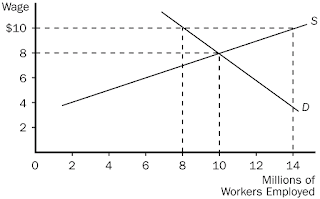
11. It has been argued that a “living wage” should be established by government, a wage that would provide workers a reasonable standard of living in their city or region. If a living wage of $10 per hour is established in the market described here, we would expect
a. employment will increase to 14 million.
b. employment will decrease to 8 million.
c. the wage will actually rise to $20 per hour.
d. there will be a surplus of 14 million workers.

Chapter 19: Earnings and Discrimination - Principles of Economics Test Bank Mankiw


12. When unions are successful in raising the wages of their members, the employers of the unionized workers tend to
a. seek substitutes for union labor.
b. acquire less capital.
c. lower the prices of the goods they sell.
d. overcome the disadvantages of higher costs by lowering management salaries.

13. The UMWA, a union for coal miners, argues that the shift from coal to non-fossil fuels as an energy source had a negative effect on coal miners’ incomes. This happened because the
a. value of marginal product curve for labor shifted to the right.
b. value of marginal product curve for labor shifted to the left.
c. price elasticity of demand for coal decreased.
d. demand for coal shifted to the right.

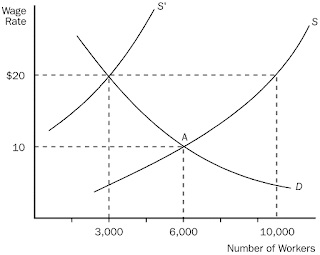
14. This figure depicts labor demand and supply in a nonunionized labor market. The original equilibrium is at point A. If a labor union subsequently establishes a union shop and negotiates an hourly wage of $20, then there will be an excess
a. supply of 3,000 workers.
b. demand of 7,000 workers.
c. supply of 4,000 workers.
d. supply of 7,000 workers.
Chapter 19: Earnings and Discrimination - Principles of Economics Test Bank Mankiw


15. This figure depicts labor demand and supply in a nonunionized labor market. The original equilibrium is at point A. If a labor union subsequently establishes a union shop and negotiates an hourly wage of $20, then the employment level
a. rises from 6,000 to 10,000.
b. rises from 3,000 to 10,000.
c. drops from 10,000 to 3,000.
d. drops from 6,000 to 3,000.

16. The idea of paying workers an efficiency wage is that
a. doing so is more efficient than paying them the market wage.
b. paying workers less gives them the incentive to work harder.
c. workers and management gain at the expense of the stockholders of the company.
d. workers have the incentive to do high-quality work.

17. If men, on average, earn 20 percent more than women in a particular occupation,
a. this is clear evidence of discrimination.
b. some of this differential could be due to differences in human capital.
c. most but not all of the differential is due to discrimination.
d. comparable worth laws must be in effect.

18. When members of a group enjoy different opportunities that cannot be attributed to differences in ability,
a. discrimination is said to occur.
b. comparable worth laws are ineffective.
c. all wages in the market will be the same.
d. the demand for labor will increase.

19. If an employer begins to pay higher wages to white workers, then in the short run
a. wages for white workers would fall.
b. wages for nonwhite workers would rise.
c. profits would rise as nonwhite workers leave the firm.
d. profits would fall as nonwhite workers leave the firm.

20. A labor market is divided into two segments. All workers have the same qualifications and find jobs in either segment equally attractive. Initially, both segments are in competitive equilibrium. If the development of employer prejudice then reduces the employment of minorities in one segment, there will be a
a. permanent drop in labor supply in the discriminating segment.
b. permanent increase in labor supply in the nondiscriminating segment.
c. temporary drop in labor supply in the discriminating segment.
d. permanent drop in labor demand in the discriminating segment.

21. A labor market is divided into two segments. All workers have the same qualifications and find jobs in either segment equally attractive. Initially, both segments are in competitive equilibrium. Then the development of employer prejudice then reduces the employment of minorities in one segment. In the long run, there will likely be a change in
a. wage rates and the composition of the work force in both segments.
b. neither wage rates nor the composition of the work force in either segment.
c. wage rates but not the composition of the work force in both segments.
d. the composition of the work force but not wage rates in both segments.

22. Prejudice can generate market forces that lead to a permanent shift of an unfavored minority into low-wage jobs when the prejudice originates with
a. employees or customers.
b. employers, employees, or customers.
c. employees only.
d. customers only.

23. Market forces encourage discrimination in the case of
a. statistical discrimination only.
b. employee and customer prejudice only.
c. employer prejudice only.
d. statistical discrimination and employee or customer prejudice.

24. One difficulty with the idea of comparable worth is that
a. it does not address the idea of compensating wage differentials.
b. it would cause wages to fall in many occupations.
c. a government agency cannot accurately evaluate the many different characteristics of the many different jobs in the labor market.
d. it would not take into account differences in the demand for labor among firms.

25. Comparable worth policies can have effects similar to
a. efficiency wages in that employment may rise in the affected markets.
b. minimum wages in that surpluses of labor may occur in the affected markets.
c. government regulation in the case of natural monopolies.
d. economies of scale in that efficiencies are created by increases in output.


Pretty.Much
Chapter 18 The Markets for the Factors of Production
1. The demand for labor by a particular firm is ultimately derived from
a. the productivity of labor.
b. the productivity of the firm’s other inputs.
c. demand for the firm’s output.
d. the market supply of labor.

2. If the demand for automobiles increases, which of the following markets would also experience an increase in demand?
a. automobile workers
b. bicycle manufacturers
c. bus drivers
d. financial analysts

3. Which of the following is an assumption made about a competitive labor market?
a. A firm must offer a higher wage rate to attract more labor.
b. A firm must offer a lower wage rate to attract more labor.
c. A firm cannot influence the market wage rate.
d. The labor supply curve facing a firm is relatively inelastic.

4. If eight workers can manufacture 70 tables per day and nine workers can manufacture 90 tables per day, and if tables can be sold for $10 each, the value of marginal product of the ninth worker is
a. 20 tables.
b. 90 tables.
c. $200.
d. $900.

5. An increasing marginal product of labor would be most commonly found
a. at high levels of employment.
b. in perfect competition.
c. at low levels of employment.
d. when prices are rising.

6. If a firm is a price taker in the labor market, then the value of the marginal product of labor equals labor’s marginal
a. product.
b. product multiplied by the price of the final product.
c. product times the wage rate.
d. product divided by the wage rate.

7. Value of marginal product is defined as the additional
a. output a firm would receive after hiring one more unit of resource.
b. cost of hiring one more unit of resource.
c. revenue earned by selling one more unit of product.
d. revenue earned by hiring one more unit of resource.

Chapter 18 The Markets for the Factors of Production

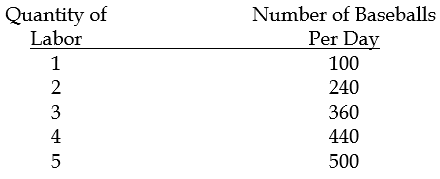
8. This table describes the number of baseballs a manufacturer can produce per day with different quantities of labor. Each baseball sells for $5 in a competitive market. For which level of employment is the marginal product of labor greatest?
a. 1 worker
b. 2 workers
c. 3 workers
d. 4 workers

9. This table describes the number of baseballs a manufacturer can produce per day with different quantities of labor. Each baseball sells for $5 in a competitive market. The total revenue per day for the firm if it employs five workers is
a. $500.
b. $300.
c. $2200.
d. $2500.

10. This table describes the number of baseballs a manufacturer can produce per day with different quantities of labor. Each baseball sells for $5 in a competitive market. The value of marginal product when marginal product is maximized is
a. 140 baseballs.
b. $300.
c. $400.
d. $700.

11. The imposition of tariffs and quotas on imported goods tends to cause the
a. demand curve for domestic labor to shift to the right.
b. demand curve for domestic labor to shift to the left.
c. supply curve of domestic labor to shift to the right.
d. supply curve of domestic labor to shift to the left.

12. Bill is trying to convince the owner of a pizza shop to hire him. He argues that he could help the shop sell an additional five pizzas per day at the market price of $8 each. If the facts are not in dispute, but the owner does not hire him, then
a. the wage rate must be less than $40 per day.
b. hiring Bill would involve a negative marginal product.
c. the wage rate must be more than $40 per day.
d. the wage rate must be less than $8 per day.

13. A labor supply curve that has a negatively sloped portion is said to be
a. a zero elasticity of labor supply.
b. a kinked labor supply curve.
c. backward bending.
d. perfectly inelastic.

14. The migration of unskilled workers from Mexico to the United States tends to
a. increase the number of jobs for unskilled American workers.
b. decrease the wage rate for unskilled American workers.
c. increase the wage rates for skilled American workers.
d. decrease the number of jobs for skilled American workers.

15. A decrease in the supply of auto workers could be the result of
a. higher wages paid to workers in other industries.
b. an increase in the value of the marginal product of auto workers.
c. improving tastes and preferences for automobiles.
d. an increase in the total product of auto workers.

16. This table shows the number of calculators that can be assembled per month by various numbers of workers. If the price per calculator in a perfectly competitive product market is $20, how many workers would the firm employ if the monthly wage rate is $1000?
a. 1
b. 2
c. 3
d. 4

Chapter 18 The Markets for the Factors of Production

17. Wally’s Wheat Farm sells its output and hires its labor in perfectly competitive markets. In the short run, Wally can vary only one input—labor. When Wally is producing in short-run equilibrium, all of the following conditions, except one, will necessarily be satisfied. Which is the exception?
a. The value of marginal product of labor equals the wage rate.
b. The marginal cost curve crosses the marginal revenue curve from below.
c. Marginal revenue equals the price of the firm’s output.
d. The firm’s total revenue will decrease if more labor is hired.

18. A perfectly competitive firm should hire additional units of labor in a competitive labor market when
a. marginal revenue is less than marginal cost.
b. the value of marginal product exceeds the wage rate.
c. total revenue exceeds total cost.
d. the marginal product of labor exceeds the wage rate.

ANSWER: b the value of marginal product exceeds the wage rate.
SECTION: 3 OBJECTIVE: 3

19. Concerning the market for radio assemblers, assume that the wage rate is $12 per hour in the U.S. and $3 per hour in Mexico. Also suppose that the marginal product of a Mexican worker is 3 radios per hour. A U.S. worker will be less costly to employ than the Mexican worker if the marginal product of the U.S. worker is at least
a. 4 radios per hour.
b. 8 radios per hour.
c. 12 radios per hour.
d. 16 radios per hour.

20. A new technology that increases the productivity of teachers has what effect on the labor market for teachers?
a. The wage rate will rise, and quantity of teachers employed will fall.
b. The wage rate will rise, and the quantity of teachers employed will rise.
c. The wage rate will fall, and quantity of teachers employed will fall.
d. The wage rate will fall, and the quantity of teachers employed will rise.

21. If the productivity of capital increases, the
a. supply curve of capital shifts to the right.
b. interest rate decreases.
c. firm’s VMP of capital increases.
d. firm’s VMP of capital decreases.

22. The value of marginal product of capital is the increase in
a. output that results from employing one more unit of capital.
b. profit that results from employing one more unit of capital.
c. revenue that results from employing one more unit of labor.
d. revenue that results from employing one more unit of capital.

23. When the price of capital increases, the
a. quantity demanded of loanable funds by the firm will decrease.
b. quantity demanded of loanable funds by the firm will increase.
c. firm’s VMP of capital increases.
d. firm’s MP of capital increases.

24. Human capital is
a. the plants and equipment owned by people.
b. computers, autos, and other durable goods owned by households.
c. the amount of money people save.
d. the skills, knowledge, and abilities of people.

25. A decrease in population can be expected to
a. raise land rent.
b. increase the supply of land.
c. decrease the demand for land.
d. increase the demand for land.

Pretty.Much
Chapter 17 Monopolistic Competition - Principles of Economics Test Bank Mankiw
Chapter 17 Monopolistic Competition

1. Because monopolistically competitive firms produce differentiated products, each firm
a. faces a demand curve that is horizontal.
b. faces a demand curve that is vertical.
c. has no control over product price.
d. has some control over product price.

2. Which of the following conditions distinguishes monopolistic competition from perfect competition?
a. number of sellers
b. freedom of entry and exit
c. small size firms
d. differentiation of product

3. If existing fast-food firms realize sizable economic profits in the short run, the demand curves of existing firms will
a. decrease and become more elastic.
b. decrease and become less elastic.
c. increase and become more elastic.
d. increase and become less elastic.

4. When a monopolistically competitive firm raises its price,
a. quantity demanded falls to zero.
b. quantity demanded declines, but not to zero.
c. the market supply curve shifts outward.
d. quantity demanded remains constant.

5. There are several reasons why demand curves may become more elastic. Among them are
a. the market becomes more monopolistic and cross elasticities approach zero.
b. the goods become less differentiated and more firms enter the industry.
c. consumers have fewer substitutes and firms drop out of the industry.
d. industry demand increases and consumers increase spending.

6. Which of the following is a characteristic of oligopoly or monopolistic competition, but not perfect competition?
a. advertising and sales promotion
b. profit maximization according to the MR = MC rule
c. firms being price takers rather than price makers
d. horizontal demand and marginal revenue curves

7. Product differentiation allows the firm to
a. raise price and lower quantity demanded.
b. raise price without suffering a substantial loss of sales.
c. shift the market demand curve to the left.
d. decrease barriers to entry.

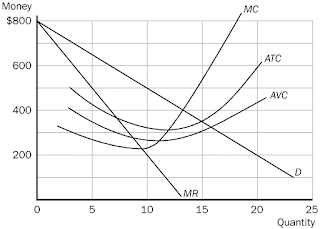
8. The maximum total short run economic profit, or minimum loss, for the monopolistically competitive firm in this figure is
a. zero.
b. a profit of $575.00.
c. a profit of $2,000.00.
d. a loss of $375.00.
Chapter 17 Monopolistic Competition


9. The firm in this figure is monopolistically competitive. It illustrates
a. the shut-down case.
b. a long-run economic profit.
c. a short-run economic profit.
d. a short-run loss.

10. At the profit-maximizing, or loss-minimizing, output level, the firm in this figure has total costs approximately equal to
a. $2000.
b. $3000.
c. $3600.
d. $800

11. Assume the firm in the figure is currently producing 8 units of output and charging $380. The firm
a. will increase its profits if it raises its price and reduces its production level.
b. will increase its profits if it lowers its price and expands its production level.
c. is maximizing profits.
d. will increase its profits if it raises its prices and expands its production level.

12. Cecilia’s Café is a monopolistic competitor. If Cecilia’s is currently producing at the output level where her average total cost is minimized and the café is earning economic profits, then in the long run output will
a. decrease and average total cost will increase.
b. decrease and average total cost will decrease.
c. remain unchanged as Cecilia’s is doing the best it can.
d. increase and average total costs will decrease.

13. In the long run, freedom of entry into a market forces a __________ to charge a price equal to average total cost, but average total cost exceeds its minimum level.
a. perfectly competitive firm
b. monopolistically competitive firm
c. oligopolistic firm
d. pure monopoly

14. Which of the following best describes the idea of excess capacity in monopolistic competition?
a. Firms produce more output than is socially desirable.
b. The output produced by a typical firm is less than what would occur at the minimum point on its ATC curve.
c. Due to product differentiation, firms choose output levels where P > ATC.
d. Firms keep some surplus output on hand in case there is a shift in the demand for their product.

15. Which of the following individuals quoted below is least likely to argue that excess capacity in monopolistically competitive industries is a waste of resources?
a. “An automobile is transportation, nothing else.”
b. “Tomatoes or no tomatoes. The choice of toppings on a burger can be important to a consumer these days when individualism is increasingly important to people.”
c. “Gasoline is gasoline no matter what the brand name.”
d. “I take the airline that will get me from A to B at the lowest price.”

16. The traditional view of monopolistic competition holds that this type of industrial structure is inefficient because
a. there are too few firms to reach an efficient level of production.
b. firms do not operate at the output that minimizes average costs.
c. advertising is not used extensively enough to yield an efficient differentiation of the products.
d. consumers do not have enough choice among the product varieties available.

17. Monopolistic competition is considered by some to be inefficient because
a. price exceeds marginal cost.
b. output exceeds capacity output.
c. long-run profits are positive.
d. All of the above are correct.

18. Perhaps it’s not a problem at all, but if “too much choice” is a problem for consumers, it would occur in which market structure(s)?
a. perfect competition
b. monopoly
c. monopolistic competition
d. perfect competition and monopolistic competition

19. Which of the following might be an effect of advertising?
a. increased product differentiation
b. increased total costs of production
c. increased demand for the product
d. All of the above are correct.

20. In the long run under monopolistic competition, when firms advertise,
a. they will still earn zero economic profit.
b. they can earn positive economic profit by increasing market share.
c. the market price must fall.
d. the market price must rise.

21. Advertising
a. provides information about products, including prices and seller locations.
b. has been proven to increase competition and reduce prices compared to markets without advertising.
c. signals quality to consumers, since firms spend so much money on ads.
d. All of the above are correct.

22. Critics of advertising argue that advertising
a. wastes resources because it creates an image without necessarily improving product quality.
b. advertising lowers barriers to entry into an industry because new firms can more easily establish themselves as competitors.
c. advertising increases competition by providing information about prices.
d. advertising encourages monopolization of markets by raising entry barriers too high.

23. Many airlines promise “frequent flyer” miles to passengers who fly their airlines regularly. This is an example of a firm attempting to create
a. price discrimination.
b. a predatory pricing scheme.
c. discounting below marginal costs.
d. brand loyalty.

24. One of the reasons that Kodak and Fuji films advertise so much is that
a. each hopes to create a natural monopoly.
b. they are in a perfectly competitive industry where advertising is the difference between economic and normal profits.
c. they want to develop brand loyalty.
d. they want to increase price elasticities of demand.

25. If some coffee drinkers continue to buy Maxwell House coffee even when Folger’s coffee is on sale and cheaper, it may be a result of
a. irrational consumer behavior.
b. a high cross elasticity between the two goods.
c. brand loyalty.
d. Maxwell House being a monopoly.

Pretty.Much